

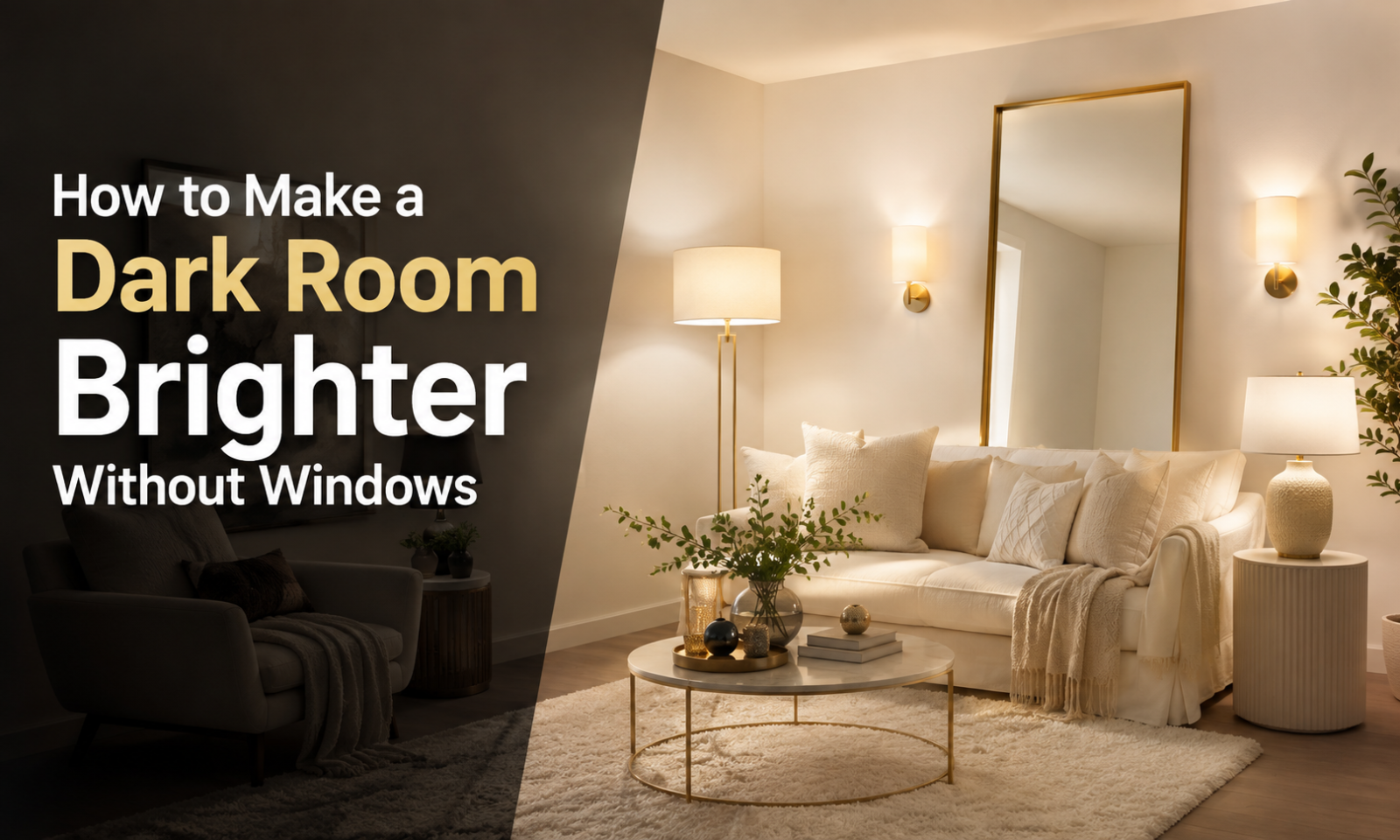
Adding a window means cutting into a wall, permits, and real expense. Most of the time it is not an option anyway, like an interior room, a basement, or a rental.
The good news: you can make a dark room dramatically brighter without a single new window. The trick is to understand what “bright” actually means to the eye, then engineer it with light, reflection, and color.
Do it well and a gloomy room turns warm, open, and inviting.
Quick answer: Brighten a dark room without windows by doing four things: layer several light sources instead of relying on one overhead fixture, bounce that light with mirrors and reflective surfaces, paint walls and ceiling a light color with a high reflectance, and choose the right bulbs (high lumens, the right color temperature, and a high color-rendering index). The single most powerful idea is to light your walls, not just the room, because the eye reads bright vertical surfaces as a bright room.
What actually makes a room feel bright?
Here is the insight that changes everything, and most guides never say it.
Your brain judges how bright a room is mostly by how bright the walls look, not the floor or the center of the room. Bright vertical surfaces read as a bright space. Dark, shadowy walls read as a dark space, even if the floor is well lit.
That reframes the whole project. The goal is not “add a brighter bulb in the middle of the ceiling.” The goal is to get light onto the walls and ceiling, and to make those surfaces bounce it back.
Everything below serves that goal.
Step 1: Layer your light (the biggest fix)
One overhead fixture creates a single pool of light and leaves the corners and walls in shadow. That is what makes a room feel dark. The fix is layering.
Aim for three types of light:
- Ambient: general fill, like the overhead fixture, brightened with floor and table lamps.
- Task: focused light where you work or read.
- Accent: light that highlights walls, art, and corners.
Arrange your light sources so they form a triangle around the room rather than sitting in one spot. Spreading light to the edges kills the shadowy corners that make a room feel gloomy. Skip heavy, ornate fixtures that overwhelm a dark space, and favor several modest sources over one big one.
In a windowless room, go a little stronger than usual on total output, since there is no daylight helping.
Step 2: Light the walls and ceiling
This is where the “brightness is a wall phenomenon” idea becomes action.
- Uplighters and wall sconces throw light upward onto the ceiling and walls. The more light you get up high, the brighter the whole room reads. Wall lights placed around the room erase dark corners.
- Perimeter lighting puts light sources around the edges so the walls and corners are lit, not just the middle.
- Wall washing aims light across a wall to make the surface itself glow.
Lighting the vertical surfaces does far more for perceived brightness than a single bright fixture overhead.
Step 3: Bounce it with mirrors and reflective surfaces
If you cannot add a window, a mirror is the next best thing. It acts like a fake window, reflecting light around the room.
- Place a large mirror near or opposite a light source so it bounces that light back into the space.
- Position two mirrors across from each other for a sense of depth and more reflection.
- Add other reflective surfaces: glossy tiles, satin or lacquered furniture finishes, metallic decor, glass and acrylic pieces. They all pass light along instead of absorbing it.
For the reflected light to feel pleasant rather than glaring, pair mirrors with warm or ambient light rather than harsh cool light.
Step 4: Paint for maximum bounce (and use LRV)
Dark colors absorb light. Light colors reflect it. This is the cheapest, highest-impact change you can make.
Paint the walls, trim, and ceiling a light color. Go for a clean, vibrant white rather than a muddy off-white, cream, or beige, which absorb more than people expect.
Here is a specification that most articles skip: Light Reflectance Value, or LRV. Every paint color has an LRV from 0 (absorbs all light) to 100 (reflects all light). For a dark room, choose a color with a high LRV, ideally in the mid-80s or above. It is printed on the paint chip. Picking by LRV takes the guesswork out of “which white is brightest.”
A note on finish: a flat or matte finish scatters light softly and evenly and hides wall flaws, while a slight sheen bounces a bit more light. Either works. If the walls are smooth, a touch of sheen adds bounce.
Step 5: Choose the right bulbs (lumens, Kelvin, and CRI)
Not all light is equal. Three specs matter, and the third is the one almost nobody mentions.
Lumens measure brightness. In a windowless room, choose high-lumen LED bulbs so you are not fighting the dark with weak light.
Kelvin measures color temperature:
- Around 2700K is warm and cozy, good for living spaces and evenings.
- Around 4000K is neutral, clean and balanced.
- 5000K and up is daylight, closest to noon sun, best for mimicking natural light in a workspace.
For a dark room you want to feel natural, daylight bulbs read most like a sunny day. If you want the room to feel warm and comfortable rather than clinical, lean warmer. Many people mix: daylight for task areas, warmer for lounging.
CRI, the Color Rendering Index, is the secret spec. It measures how accurately a bulb shows colors, on a scale to 100. Cheap bulbs with a low CRI make a room look dull and flat, so colors go grey and lifeless. A bulb with a high CRI (90 or above) makes colors pop and the room feel naturally lit, the way sunlight does. Two bulbs can have identical brightness and color temperature, yet the high-CRI one makes the room feel alive. Always check the CRI.
Step 6: Lighten everything else
Once the light and walls are handled, stop the room from absorbing what you have gained.
- Choose light-colored furniture, rugs, and textiles. Dark pieces soak up light.
- Swap heavy dark curtains for light, airy fabrics. If the room has even a small window, sheers let light through while keeping privacy.
- Use glass or acrylic furniture to let light pass through instead of blocking it.
- Reduce clutter, which casts small shadows and eats light.
- Add a low-light plant for life and freshness.
- Clean your existing fixtures and any glass. Dust on bulbs and glass quietly cuts brightness.
Quick reference: effort versus payoff
| Move | Effort | Payoff |
|---|---|---|
| Layer in lamps and sconces | Low | Very high |
| Uplight the walls and ceiling | Low | Very high |
| Large mirror near a light | Low | High |
| Light paint, high LRV | Weekend | Very high |
| High-lumen, high-CRI bulbs | Minutes | High |
| Light furniture and textiles | Varies | Medium |
Frequently asked questions
How do I brighten a room with no natural light at all?
Layer several light sources, light the walls and ceiling with uplighters and sconces, add mirrors near those lights, paint everything a high-reflectance light color, and use high-lumen, high-CRI bulbs. Together these fake a bright, daylit feel.
What paint color makes a dark room brightest?
A clean, vibrant white with a high Light Reflectance Value, ideally in the mid-80s or above. Check the LRV on the paint chip. Avoid muddy off-whites, cream, and beige, which absorb more light than they look like they will.
What light bulbs are best for a dark room?
High-lumen LED bulbs with a color temperature that suits the room (daylight around 5000K to mimic sun, warmer for cozy spaces) and a high CRI of 90 or more, so colors look rich and the light feels natural.
Do mirrors really brighten a room without windows?
Yes. A mirror reflects both artificial and any available light around the room, acting like a fake window and making the space feel bigger and brighter. Place it near or opposite a light source for the best effect.
Why does my room still feel dark even with the light on?
Usually because a single overhead fixture leaves the walls and corners in shadow, or the bulb has low output or a low CRI. Add layered lighting aimed at the walls, and switch to brighter, high-CRI bulbs.