

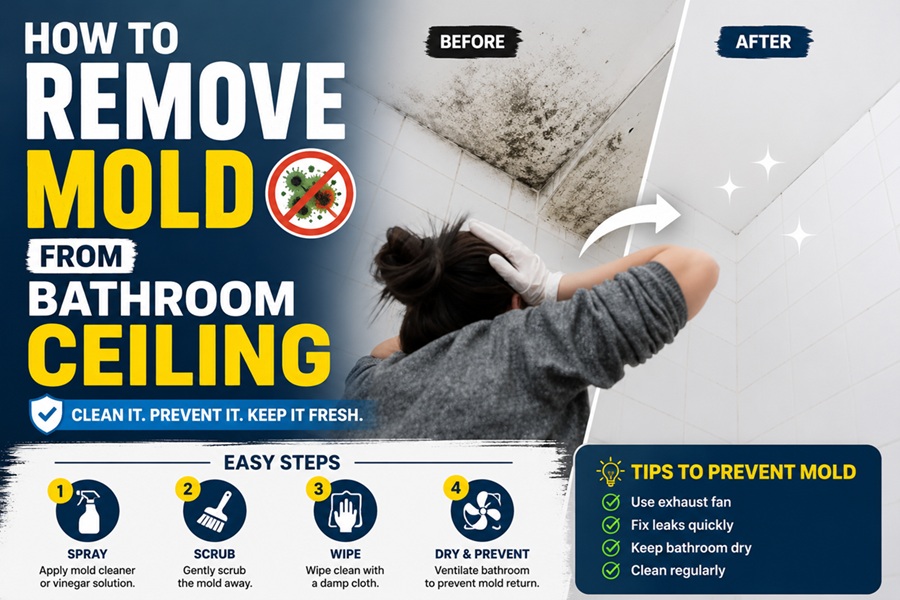
To remove mold from a bathroom ceiling, put on gloves, eye protection, and an N95 mask, ventilate the room, then spray the area with undiluted white vinegar and let it sit for about an hour before scrubbing gently and wiping clean. Vinegar works on most bathroom ceiling mold, and it is safer than bleach because it penetrates rather than just bleaching the surface color. Dry the area thoroughly afterward, then fix the moisture problem that caused it, or the mold will simply return.
That last part matters more than the cleaning itself. Bathroom ceiling mold is almost always a ventilation problem, not a cleaning problem. Steam rises, sits against a cool ceiling, and condenses, giving spores exactly what they need. This guide covers how to clean it safely, which solutions actually work, and how to stop it coming back.
| Bathroom Ceiling Mold: Quick Facts | |
| Main cause | Poor ventilation and trapped humidity |
| Best DIY cleaner | Undiluted white vinegar |
| Other options | Baking soda paste, hydrogen peroxide, diluted bleach |
| Never mix | Bleach with vinegar or ammonia, it creates toxic gas |
| Protective gear | Gloves, eye protection, N95 mask |
| Time needed | About 1 to 2 hours including dwell time |
| Call a professional if | The area is larger than about 10 square feet |
| Key prevention | Run the exhaust fan during and after every shower |
Is It Mold or Just Mildew?
People use the words interchangeably, but there is a practical difference worth knowing before you start scrubbing. Mildew is a surface growth, usually flat, powdery, and white or grey, and it wipes away fairly easily. Mold tends to be fuzzy or slimy, appears in black, green, or brown patches, and penetrates the surface it grows on.
For a bathroom ceiling, mildew is the easier scenario, since a good clean usually handles it completely. Mold requires the fuller treatment described below and is more likely to return if the moisture source is not fixed. Either way, the cleaning method is broadly the same, so if you are unsure, treat it as mold and take the full precautions.
What Causes Ceiling Mold in the First Place
Understanding the mechanism helps you prevent it properly. Every hot shower fills the room with steam. That warm, moisture-heavy air rises and meets the ceiling, which is typically the coolest surface in the room, especially if there is an unheated attic or roof space above it.
When warm moist air touches a cool surface, it condenses into a thin film of water. If that film cannot evaporate quickly, it stays long enough for airborne spores to settle and take hold. Repeat that twice a day for a few months and you have visible growth. This is why the corners and the area directly above the shower are almost always affected first, and why ventilation matters more than any cleaning product.
Safety First
Mold is not something to tackle casually, especially overhead where spores and cleaning spray fall toward your face. A few precautions make the job much safer.
- Wear an N95 mask, rubber gloves, and goggles that seal around the eyes
- Open windows and run the exhaust fan for cross ventilation
- Cover the floor and any fixtures with plastic sheeting or old towels
- Use a stable step ladder rather than balancing on the tub edge
- Take breaks and leave the room if you feel lightheaded or irritated
Critical warning: never mix bleach with vinegar, ammonia, or other cleaning products. Those combinations release toxic gases that can cause serious respiratory harm. Use one product at a time, and rinse thoroughly before switching to another.
Some people should not do this job themselves at all. If you have asthma, a respiratory condition, a mold allergy, or a weakened immune system, exposure carries real risk. Have someone else handle it or bring in a professional.
Choose Your Cleaning Solution
Several household options work, and each has strengths. Here is how they compare for a painted bathroom ceiling.
| Solution | How to use it | Best for |
| White vinegar | Spray undiluted, wait 1 hour | Most bathroom mold, safest option |
| Baking soda paste | Mix with water, apply, scrub | Light mold and deodorizing |
| Hydrogen peroxide | Spray 3 percent, wait 10 minutes | Stubborn spots, mild bleaching |
| Diluted bleach | About 1 cup per gallon of water | Non-porous surfaces only |
Vinegar is the best starting point for most people. It kills a broad range of mold species and, unlike bleach, it soaks into slightly porous surfaces rather than only lightening what you can see. Bleach often removes the stain while leaving roots behind, which is why mold treated with bleach so often returns in the same spot.
Step-by-Step Removal
Step 1: Prepare the room
Clear out towels, toiletries, and anything you do not want splattered. Lay down protective covering. Open a window and switch on the exhaust fan. Set up your ladder so you can reach comfortably without stretching.
Step 2: Apply the solution
Fill a spray bottle with undiluted white vinegar and mist the affected area generously. Do not scrub yet. The vinegar needs time to work, so let it sit for around an hour. Spraying rather than soaking limits drips onto your face and floor.
Step 3: Scrub gently
Use a soft brush or sponge and work in small circles. Be gentle. Bathroom ceilings are usually painted drywall, and aggressive scrubbing damages the paint and can tear the paper facing underneath, creating a bigger repair job than the mold.
Step 4: Wipe and rinse
Wipe the area with a clean damp cloth to lift residue and loosened spores. Rinse the cloth frequently in a bucket rather than the sink, and dispose of heavily contaminated cloths rather than reusing them.
Step 5: Dry thoroughly
This step gets skipped and it should not. Any lingering moisture invites the mold straight back. Run the exhaust fan, open windows, and point a fan at the ceiling until the surface is completely dry to the touch. Give it several hours.
Step 6: Repaint if needed
If staining remains after cleaning, prime the area with a stain-blocking primer and repaint using a mold-resistant paint made for bathrooms. Do not paint over active mold, as it will keep growing beneath the surface and push through.
Fix the Cause, Not Just the Symptom
Cleaning without addressing moisture is a temporary victory. Bathroom ceiling mold happens because warm, wet air has nowhere to go. Work through these before considering the job finished.
- Ventilation: run the exhaust fan during every shower and for 20 to 30 minutes afterward
- Fan capacity: an undersized or failing fan cannot clear the steam, so test that yours actually pulls air
- Leaks: check for plumbing or roof leaks above the bathroom, since persistent mold in one spot often points to one
- Humidity: aim to keep indoor humidity below about 50 percent, using a dehumidifier if needed
- Airflow: leave the bathroom door open after showering to let moisture disperse
Preventing Mold From Coming Back
Once the ceiling is clean and dry, a handful of habits keep it that way.
- Squeegee shower walls and wipe down wet surfaces after use
- Hang towels to dry fully rather than leaving them bunched
- Repaint the ceiling with mold-resistant paint when it is next due
- Keep the exhaust fan grille clean so it moves air efficiently
- Take shorter or slightly cooler showers to reduce steam volume
- Inspect the ceiling every few months so you catch new growth early
When to Call a Professional
Do-it-yourself removal has limits, and pushing past them can spread spores or leave a hidden problem growing. Bring in a remediation specialist in these situations.
- The affected area is larger than roughly 10 square feet
- Mold keeps returning to the same place despite repeated cleaning
- You suspect it extends behind the drywall or into the ceiling cavity
- The growth followed a flood, sewage backup, or contaminated water
- Anyone in the household has asthma, allergies, or immune concerns
- There is soft, sagging, or crumbling drywall, which suggests deeper damage
Recurring mold in one specific spot is a particularly strong signal. It usually means water is reaching that area from somewhere you cannot see, and no amount of surface cleaning will resolve it.
Frequently Asked Questions
What kills mold on a bathroom ceiling?
Undiluted white vinegar is the most effective safe option for most bathroom ceilings. Baking soda paste and hydrogen peroxide also work, while diluted bleach is best reserved for non-porous surfaces.
Is vinegar or bleach better for ceiling mold?
Vinegar is generally better for painted ceilings because it penetrates the surface rather than only lightening the stain. Bleach often removes the discoloration while leaving mold roots behind, so growth returns.
Why does mold keep coming back on my ceiling?
Almost always because moisture remains. Inadequate ventilation, a failing exhaust fan, high humidity, or a hidden leak above the ceiling will regrow mold no matter how thoroughly you clean.
Is it safe to remove bathroom mold myself?
For small areas, yes, with gloves, goggles, an N95 mask, and good ventilation. People with asthma, allergies, or immune conditions should avoid the job, and areas over about 10 square feet warrant a professional.
Can I just paint over the mold?
No. Painting over active mold traps it and lets it keep growing underneath until it pushes through. Clean and fully dry the area first, then use a stain-blocking primer and mold-resistant paint.